
We Buy
Fine Porcelain
Limoges, Lladró, Royal Crown Derby, Royal Doulton and other hand-finished porcelain houses.
What Makes Fine Porcelain Collectible
Fine porcelain has been collected for centuries for its craftsmanship, hand-painted or hand-applied decoration, and the prestige of the workshops and makers behind it. Collectible value is driven by factors such as age, rarity, condition, pattern desirability, hand-finishing versus mass production, and the presence of clear, datable backstamps or factory marks. Many of the makers below trace their origins to the great English, French, and Spanish porcelain traditions of the 18th to 20th centuries, and pieces from discontinued patterns, early production runs, or limited editions typically command the highest prices.
Makers & Items We Buy
Limoges
"Limoges" refers not to a single factory but to fine hard-paste porcelain produced in and around Limoges, France, a region where rich deposits of kaolin clay were discovered in the 1760s-70s, giving rise to dozens of porcelain houses (most famously Haviland, founded 1842) from the late 18th century onward. Limoges porcelain is prized for its exceptional whiteness, translucency, and durable glaze, achieved through intense high-temperature firing of locally sourced kaolin, feldspar, and quartz. Pieces are typically identified by a combination of a French government mark, an individual manufacturer's mark, and sometimes an artist's signature, with "France" required on export marks after 1891 and "Made in France" standard after 1914. Collectibility hinges on the maker, period, and hand-painted decoration; buyers should be alert to widespread reproductions and fake marks.
Lladró
Lladró is a Spanish porcelain house founded in 1953 near Valencia by brothers Juan, José, and Vicente Lladró, who began with simple functional wares before moving into figurines in 1955. The brand became known for a distinctive soft, pastel-glazed sculptural style with elongated, gently melancholic figures influenced by Spanish artistic tradition, and it expanded internationally after entering the US market in 1965. Genuine pieces carry the company's blue backstamp, which from 1971 has featured the "Lladró, Made in Spain" mark with a stylised flower logo. Collectible value depends heavily on rarity and retirement status: common pieces may sell for modest sums, while retired figures and works from the limited-edition High Porcelain Collection have achieved auction prices from several thousand up to tens of thousands of dollars.
Royal Albert
Royal Albert is an English bone china manufacturer established in Longton, Staffordshire, by Thomas C. Wild, with the "Royal Albert" name adopted in the late 1890s in honour of Prince Albert. The company is best known for elaborate floral tableware patterns, most notably Old Country Roses, designed by head of design Harold Holdcroft in 1962, featuring deep red, yellow, and pink roses with green leaves and 22-carat gold trim. Old Country Roses became one of the best-selling china patterns in the world, with over 100 million pieces sold, applied across tea sets, dinnerware, vases, and giftware over decades of production. Collectible value ranges from modest sums for single replacement pieces to several hundred pounds for complete, well-preserved tea and dinner services, with older and discontinued patterns generally most sought after.
Royal Crown Derby
Royal Crown Derby traces its origins to 1750 in Derby, England, when Huguenot craftsman Andrew Planche partnered with porcelain painter William Duesbury. King George III granted the right to incorporate a crown into the factory's backstamp in 1775, and in 1890 Queen Victoria's Royal Warrant formally established the "Royal Crown Derby" name. The maker is best known for its richly coloured Imari-style patterns — most famously "Old Imari" (pattern 1128, dating to 1882) — which combine cobalt blue, iron red, and lavish gold gilding in designs inspired by 17th-18th century Japanese Imari porcelain. Pieces are identified by the crowned backstamp along with pattern numbers and, on earlier examples, painters' marks. Early or hand-decorated pieces and rare historic patterns are the most collectible.
Royal Doultan Bunnykins
Bunnykins is a whimsical English tableware and figurine line introduced by Royal Doulton in 1934, originating from illustrations by Barbara Vernon Bailey (later Sister Mary Barbara), daughter of Doulton's then-general manager, depicting anthropomorphic rabbits in charming English scenes. Bunnykins figurines, sculpted by Charles Noke, followed in 1939 with an initial run of just six designs; production halted during WWII, making that first series especially rare, and figurine output did not resume until Royal Doulton acquired the Beswick factory in 1969, after which figures were catalogued with the "DB" prefix. The line's early royal association — Bunnykins ware was used by Princesses Elizabeth and Margaret — cemented its popularity as a christening and birthday gift through the 20th century. Dateable backstamps, along with early Barbara Vernon-signed pieces and limited early figurines, are key drivers of collectible value.
Shelley
Shelley China of Longton, Staffordshire, descends from the Foley Potteries, trading as Wileman & Co. from the 1850s before officially adopting the Shelley name and mark around 1910 under Percy Shelley's direction. The firm is especially celebrated for its bold, geometric Art Deco wares of the 1920s-30s, including the Eric Slater-designed "Mode" and "Vogue" shapes, alongside delicate, finely potted bone china teaware in patterns such as Dainty, Yellow Butterfly, and Apples. Pieces are typically marked on the base with variants of the Shelley shield, with earlier examples marked "Foley China" or "Wileman & Co." Since the Shelley name was retired after the company's 1966 sale to Allied English Potteries, no new Shelley china has been produced, and Art Deco shapes and complete rare-pattern tea sets are now the most highly prized among collectors.
Spode Copeland
Spode was founded in Stoke-on-Trent, England, by Josiah Spode I around 1770 and became renowned for pioneering fine blue-and-white transferware and, crucially, for perfecting the formula for English bone china. William Copeland, who had managed the firm's London business, took over on Josiah Spode II's retirement in 1812; the business traded as Spode & Copeland, then Copeland & Garrett from 1833, before passing fully to the Copeland family in 1847 and operating for over a century as W.T. Copeland & Sons — with the "Spode" name retained and often marked "Late Spode" as a mark of continuity. The firm reverted to trading as "Spode Ltd" in 1970, later merging with Royal Worcester in 2006. Because Copeland is the direct historical successor to Spode using the same factories, moulds, and many original patterns, pieces marked "Copeland" or "Copeland Late Spode" are considered part of the same continuous lineage, and we particularly value early Spode blue transferware, 19th-century Copeland Parian ware figures, and pieces bearing the transitional "Late Spode" backstamps.
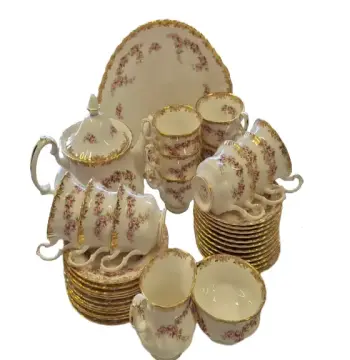
Fine Porcelain Currently For Sale
Get an Instant, No-Obligation Offer
Send us photos via WhatsApp or book a home visit — our specialists travel to you anywhere in South Africa.