
We Buy
Luxury Handblown Art Glass, Molded Glass & Cutglass
Baccarat, Murano, Lalique, Waterford and other hand-cut and hand-blown crystal and art glass.
What Makes Luxury Handblown Art Glass, Molded Glass & Cutglass Collectible
Fine art glass and crystal have been prized as luxury collectibles for centuries, spanning hand-blown Venetian masterpieces of the Renaissance to Art Deco opalescent glass and mid-century Scandinavian design. Collectors value these pieces for the skill of their maker's mark or signature, the rarity of a pattern or colour, the era in which they were produced, and the precision of hand-cutting, engraving, or moulding techniques that cannot easily be replicated by machine. Because authenticity, provenance, and condition drive value dramatically in this category, factory marks, etched signatures, and documented history are as important to buyers as the beauty of the glass itself.
Makers & Items We Buy
Baccarat
Baccarat traces its roots to a royal glassworks founded in the Lorraine town of Baccarat, France, and began producing fine lead crystal in 1816, later winning gold medals at the 1823 National Exhibition and the 1855 Exposition Universelle in Paris. The house is famed for its 1841 Harcourt stemware pattern, its Millefiori paperweights of the 1840s, and for becoming, in 1907, the first factory to manufacture crystal perfume bottles. Pieces have been marked since the 1880s with an acid-etched circular mark depicting a wine glass, carafe, and goblet alongside the word "Baccarat." We particularly prize early nineteenth-century paperweights, signed stemware patterns, and pieces noted for exceptional clarity, sharp cutting, and symmetry.
Bohemian
Bohemian glass developed in the Bohemia and Silesia regions (modern Czech Republic) from the 13th century, with the term "Bohemian glass" emerging in the 16th century to distinguish its potash-lime crystal from Italian glass. Its golden era ran from the late 17th through 19th centuries, when gem-engraving techniques adapted by Caspar Lehmann and later masters produced richly cut and wheel-engraved crystal, alongside innovations like ruby glass, black-and-gold Hyalith, and stone-imitating Lithyalin. Much mid-century Bohemian glass was left unmarked or bore only generic "Bohemia" labels. We value Bohemian glass for its elaborate cutting, engraving, and colour work, with earlier hand-crafted and lesser-seen colour combinations commanding the highest interest.
French Opalescent
French opalescent (opaline) glass rose to prominence in 19th-century France, reaching its height of popularity during the reign of Napoleon III between 1850 and 1860. Its distinctive milky, semi-translucent effect was achieved by adding opacifying agents such as bone ash, sodium phosphate, or calcium compounds to the glass mixture, producing a soft glow at the rim or body of a piece. Robin's-egg blue is the most widely collected colour, while lemon yellow is considered the rarest, and the style was later revived in Art Deco opalescent glass by makers such as René Lalique and Sabino. We seek out well-formed period pieces in rare colours, as well as documented Art Deco examples from named makers.
Murano
Glassmaking on the Venetian islands dates to the 8th century, with furnaces relocated to the island of Murano in 1291 to reduce fire risk in Venice; by the 15th century, master Angelo Barovier had developed "cristallo," a nearly transparent glass that made Murano famous across Europe. After a decline, the industry was revived in the 19th and 20th centuries by firms such as Fratelli Toso, Salviati, and later Venini and Barovier & Toso, reviving historic techniques like millefiori and filigrana alongside bold mid-century sculptural design. Authentic pieces may carry etched signatures, applied labels, or foil stickers identifying the workshop or artisan, and since 1994 genuine works can carry the collective "Vetro Artistico® Murano" trademark. Collectibility hinges on attribution to a named glasshouse or designer and distinguishing genuine Murano work from mass-produced imitations.
Orrefors
Orrefors was founded in 1898 in the Swedish village of the same name, shifting in the early 20th century to high-quality art glass under designers Simon Gate and Edward Hald, who joined in 1916-17 and pioneered figure engraving. The house became known for technical innovation, including the "Graal" cased cameo-glass technique, the "Ariel" technique developed by Vicke Lindstrand and Edvin Öhrström in the mid-1930s, and Sven Palmqvist's 1944 "Kraka" method, alongside award-winning showings at the 1925 Paris Exposition. Orrefors merged with Kosta Boda in 1990, and the company used varying engraved signature systems over the decades to identify designer and pattern. We focus especially on pre-1980 pieces and designer-signed works, prizing the thinner glass walls typical of earlier production.
Riedel
Riedel is an Austrian glassware house whose family glassmaking business dates to 1756 in Bohemia; after losing its factories in the aftermath of the Second World War, the family re-established itself in Kufstein, Austria, in 1956 under Walter and Claus Riedel. In the late 1950s and 1960s, Claus J. Riedel revolutionised wine service by designing stemware shaped specifically to enhance the aroma and taste of individual wine varietals, culminating in the 1973 Sommeliers series, regarded as the world's first grape-variety-specific glassware. Hand-blown Riedel crystal is still crafted in Kufstein, while machine-made lines are produced in Germany. It is collected both for vintage hand-blown pieces and for its design-driven, functionally engineered stemware.
R. Lalique
René Lalique (1860-1945) began his career as a jewellery designer before turning to glass in the early 20th century, founding a glassworks renowned for Art Deco vases, car mascots, and perfume bottles, including a long collaboration with perfumer François Coty from 1907. Pieces made during his lifetime were signed "R. Lalique," typically engraved, moulded, etched, or sandblasted into the base, while after his death in 1945 his son Marc converted production to full lead crystal and used the mark "Lalique France." Pre-1945 "R. Lalique" pieces are the most sought-after and valuable among collectors, with rare examples reaching tens of thousands of dollars at auction. We watch closely for forged or reproduction pieces, particularly Czech-made glass fraudulently bearing an added "R" to mimic the earlier signature.
Rose Cut
Rose cutting originated as a gemstone and diamond lapidary technique, later adapted by glass cutters to create faceted, dome-like decorative elements within larger cut-glass motifs such as hobstars. The technique is most closely associated with the American Brilliant Period of cut glass (1876-1916) and contemporaneous European crystal, when skilled artisans used rotating stone wheels to cut deep, sparkling geometric patterns by hand, a single piece often requiring 50-60 hours of labour. Rose-cut detailing adds intense light refraction and brilliance to a piece, distinguishing genuine hand-cut work from later machine-pressed imitations. We value crisply defined, uniform rose-cut facets as a mark of quality craftsmanship, particularly on period decanters, bowls, and stemware.
Stuart
Stuart Crystal traces to 1827, when Frederick Stuart began working at the Redhouse Glassworks in Stourbridge, England's historic glassmaking district, later forming Stuart & Sons with his sons in 1881. The firm produced notable pieces such as the 1887 Stuart Medallion Cameo Glass and the 1907 Beaconsfield cutting pattern, and received a Royal Warrant in 1909 recognising it as a supplier to the British royal family. Pieces made from the 1930s onward typically carry an acid-etched "Stuart" mark on the base. The company was acquired by Waterford Wedgwood in 1995 and its Stourbridge factory closed in 2001, making earlier hand-cut Stuart pieces, especially Royal Warrant-era and discontinued patterns, increasingly collectible.
St. Louis Crystal
Saint-Louis is the oldest glass manufacturer in France, founded in 1586 in the forested Lorraine valley later renamed Saint-Louis-lès-Bitche, and was granted the title "Cristallerie royale de Saint-Louis" by Louis XV in 1767. In 1781 the house added lead to its glass formula, making it the first crystal glass manufacturer in continental Europe; it went on to introduce intricate millefiori paperweights in 1840 and a line of cameo glass in the late 19th century. Most pieces are unmarked and identified through form and provenance, though paperweights are typically signed and dated. We focus especially on cameo glass and pre-1867 paperweights; the house has been part of the Hermès Group since 1995.
Venetian
Venetian glass refers broadly to glass produced in and around Venice, historically overlapping with Murano since furnace production was concentrated there from 1291 onward for fire safety. The Golden Age of Venetian glassmaking in the 15th and 16th centuries produced the near-transparent "cristallo" glass and techniques like filigrana and latticino, with wares collected by royalty including Henry VIII and Francis I of France. The terms "Venetian" and "Murano" glass are often used interchangeably, though genuine Venetian glassmakers historically existed both on and off the island of Murano. Collectibility depends on attribution to a documented workshop or period, with buyers cautioned against inexpensive modern reproductions.
Waterford
Waterford Crystal was founded in 1783 in Waterford, Ireland, by brothers George and William Penrose, quickly earning renown for exceptional clarity and deep brilliant cutting before economic pressures forced the original factory to close in 1851. The name was revived in 1947 when Czech glassmakers Karel Bacik and Miroslav Havel established a new glassworks, with Havel creating the now-iconic Lismore pattern in 1952, which became the world's best-selling crystal design. Genuine pieces from the 1950s onward carry an acid-etched "Waterford" mark or the company's seahorse logo, while older pieces often bore paper or foil labels instead. We particularly seek limited editions, discontinued cutting patterns, and vintage Lismore stemware, which tend to appreciate as production runs end.
Luxury Handblown Art Glass, Molded Glass & Cutglass Currently For Sale
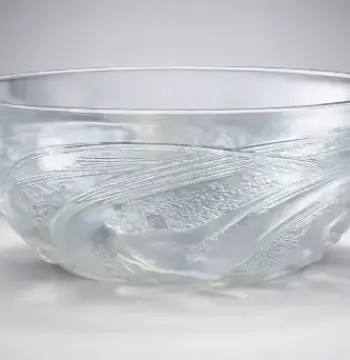
René Lalique “Ondines” opalescent glass bowl,
R58,000.00
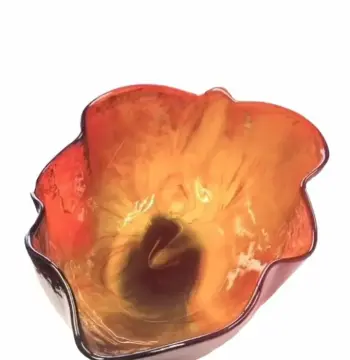
Vintage Murano freeform ruffled leaf bowl, amberina red/orange
R4,500.00
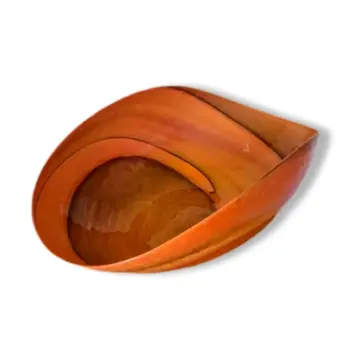
Large Vintage Murano Folded Orange Yalos Casa Signed Venetian Art Glass Bowl 51cm
R4,500.00
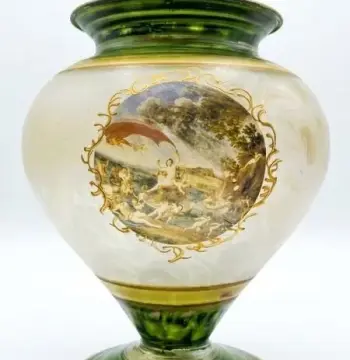
Vintage Arte Murano Italian Glass Vase - Renaissance Painted Medallion & Gold Trim
R3,000.00
Get an Instant, No-Obligation Offer
Send us photos via WhatsApp or book a home visit — our specialists travel to you anywhere in South Africa.